- English
- Español
- Português
- русский
- Français
- 日本語
- Deutsch
- tiếng Việt
- Italiano
- Nederlands
- ภาษาไทย
- Polski
- 한국어
- Svenska
- magyar
- Malay
- বাংলা ভাষার
- Dansk
- Suomi
- हिन्दी
- Pilipino
- Türkçe
- Gaeilge
- العربية
- Indonesia
- Norsk
- تمل
- český
- ελληνικά
- український
- Javanese
- فارسی
- தமிழ்
- తెలుగు
- नेपाली
- Burmese
- български
- ລາວ
- Latine
- Қазақша
- Euskal
- Azərbaycan
- Slovenský jazyk
- Македонски
- Lietuvos
- Eesti Keel
- Română
- Slovenski
- मराठी
- Srpski језик

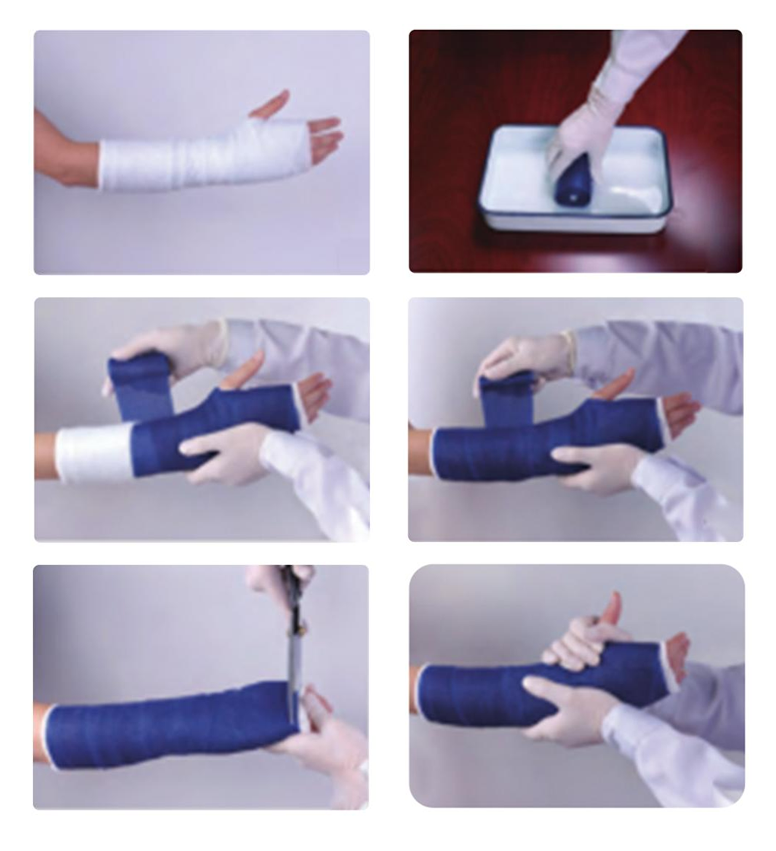
Steps for using the Orthopaedic Casting Tape
Steps for using the Orthopaedic Casting Tape
Orthopaedic casting tape, as an important material for external fixation in modern orthopedics, has significant advantages over traditional plaster casts, including being lightweight, breathable, radiolucent, quick-setting, highly malleable, and waterproof (in some models). Its correct use is crucial for fixation effectiveness, patient comfort, and rehabilitation safety.
Prepare padding: First, evenly wrap two layers of pure cotton gauze or a special cotton cover around the limb area to be immobilized, avoiding direct contact between the bandage and the skin to prevent pressure sores or allergies.
Wear gloves: The operator must wear sterile medical gloves or latex gloves to maintain hygiene and facilitate subsequent shaping.
Immersion Treatment:Remove the bandage and immerse it in room temperature water (21–24°C) for 3–6 seconds (this may vary slightly depending on the brand, but 4–5 seconds is common);
Gently squeeze 2–3 times simultaneously to fully activate the resin;
Remove and squeeze out excess water (until it is no longer dripping) to avoid excessive moisture affecting adhesion and hardening speed.
Spiral Wrapping:Begin spiral wrapping from the thinner end of the limb towards the thicker end;Each wrap overlaps the previous wrap by 1/2 to 2/3;Moderate tightness: Too loose and it will slip, reducing fixation strength; too tight and it will compress blood vessels and nerves, affecting blood circulation.
Timely Shaping (Golden 3–5 Minutes):After wrapping, immediately use gloved hands to gently press and smooth the surface to ensure each layer adheres tightly and follows the limb's contour;
Do not stretch the bandage—stretching will damage the fiber structure, weakening strength and adhesion;Shaping must be completed within 3–5 minutes; exceeding this time will cause initial setting, making shaping difficult.
Static sclerosis and functional activation: Initial sclerosis takes about 10 minutes, during which the affected limb should not be moved arbitrarily; After 30 minutes, functional weight-bearing strength can be achieved, and weight-bearing can be gradually increased in conjunction with the rehabilitation plan.
Previous:Emergency Bandage usage steps