- English
- Español
- Português
- русский
- Français
- 日本語
- Deutsch
- tiếng Việt
- Italiano
- Nederlands
- ภาษาไทย
- Polski
- 한국어
- Svenska
- magyar
- Malay
- বাংলা ভাষার
- Dansk
- Suomi
- हिन्दी
- Pilipino
- Türkçe
- Gaeilge
- العربية
- Indonesia
- Norsk
- تمل
- český
- ελληνικά
- український
- Javanese
- فارسی
- தமிழ்
- తెలుగు
- नेपाली
- Burmese
- български
- ລາວ
- Latine
- Қазақша
- Euskal
- Azərbaycan
- Slovenský jazyk
- Македонски
- Lietuvos
- Eesti Keel
- Română
- Slovenski
- मराठी
- Srpski језик

Difference between two-part and three-part syringes
Difference between two-part and three-part syringes
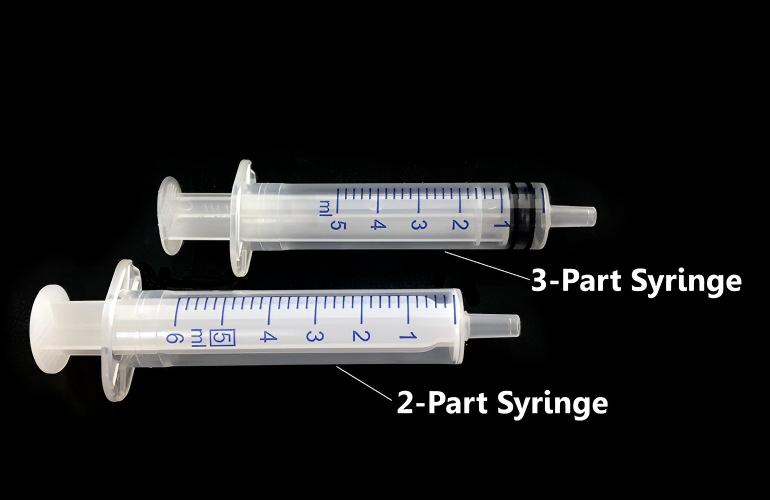
Currently, the vast majority of syringes on the market are disposable plastic syringes, primarily made of polypropylene (PP). This material boasts good chemical stability, heat resistance, and cost-effectiveness, making it widely applicable in routine medical and laboratory settings. The core value of the disposable design lies in significantly reducing the risk of cross-contamination—especially when handling toxic, highly reactive, or infectious substances, serving as a fundamental prerequisite for ensuring personnel safety and experimental reliability. The most common syringe structure is a three-part design, consisting of a barrel, a piston rod, and a piston with a rubber tip. Its sealing principle relies on a vacuum seal formed between the black rubber gasket at the piston tip and the barrel wall. To ensure smooth rubber sliding and avoid "stickiness," manufacturers typically apply a small amount of silicone oil lubricant during assembly. These syringes are also known as RTP (Rubber-Tipped Piston) syringes, or more commonly, standard/conventional/ordinary syringes. Their advantages include low cost, high adaptability, and smooth operation, making them the default choice for most scenarios. However, it's important to note that rubber components and silicone oils can be potential sources of contaminants in process-sensitive applications—for example, in chromatographic analysis, high-purity reagent transfer, or biopharmaceutical dispensing, they may leach organic matter, interfere with detection signals, or affect product stability. For applications requiring higher cleanliness and component inertness, two-part syringes offer a superior solution. Their structure consists of only the barrel and piston, completely eliminating rubber gaskets and external lubricants. The sealing mechanism is achieved through precision engineering: the piston head is slightly larger than the barrel's inner diameter, and upon insertion, it slightly expands the barrel wall to form an elastic seal, thus maintaining a reliable vacuum without the need for additional materials. A typical material combination is a polypropylene barrel and a polyethylene (PE) piston, offering chemical inertness, low leaching rates, and excellent sliding performance. This design is particularly suitable for: Gas/liquid chromatography injectionPrecise dispensing of ophthalmic medicationsQuantitative transfer of industrial-grade solvents, adhesives, and coatingsLaboratory studies highly sensitive to silicone oil residues or rubber particles.